Chapter 19 — Unemployment
Cambridge International AS & A Level Economics (9708) · Unit 4.5 · 4th edition coursebook
Learning objectives
- Define the meaning of unemployment.
- Explain the difference between the economically active and the economically inactive population.
- Explain the difference between the level of unemployment and the rate of unemployment.
- Calculate the rate of unemployment.
- Explain how unemployment is measured.
- Consider the difficulties of measuring unemployment.
- Analyse the causes and types of unemployment: frictional, structural, cyclical, seasonal and technological.
- Discuss the consequences of unemployment.
Key terms
- unemployment
- The state of being willing and able to work but not having a job.
- homemakers
- People who look after the household of their own families. For example, a parent who stays at home to look after the home and children.
- economically inactive
- People who are not in the labour force.
- labour force
- The employed and the unemployed.
- economically active
- People in the labour force.
- labour force participation rate
- The proportion of the population that are of working age and who are either working or actively seeking work.
- level of unemployment
- The number of workers who are unemployed.
- unemployment rate
- Unemployed workers as a percentage of the labour force.
- employment rate
- Employed workers as a percentage of the population of working age.
- discouraged workers
- Workers who would like a job but who have given up actively seeking work after a period of trying to find work.
- claimant count measure
- A measure of unemployment based on those claiming unemployment benefits.
- labour force survey measure
- A measure of unemployment based on a survey that identifies people who are actively seeking a job.
- sampling error
- The people being surveyed having different characteristics or experiences to the rest of the population.
- frictional unemployment
- Unemployment that is temporary and arises when workers are in-between jobs.
- voluntary unemployment
- Unemployment resulting from the unemployed choosing not to accept jobs at the going wage rate.
- search unemployment
- Unemployment that exists when people take time looking for a job they are willing to accept.
- casual unemployment
- Unemployment that occurs when people have left one short-term job and before they take up another short-term job.
- seasonal unemployment
- Unemployment arising at particular times of the year when demand for the product falls.
- structural unemployment
- Unemployment caused as a result of the changing structure of economic activity.
- regional unemployment
- Unemployment arising from a decline in job vacancies in a particular area of the country.
- technological unemployment
- Unemployment caused by advances in technology.
- international unemployment
- Unemployment arising when a country loses its international competitiveness in producing a product or products.
- cyclical unemployment
- Unemployment that results from a lack of aggregate demand.
- underemployment
- A situation where people are working fewer hours than they would like or working in jobs that they are overqualified for.
19.1Unemployment
Unemployment occurs when people who are willing and able to work cannot find a job. Not everyone who is not working is unemployed: children are too young to work, and some adults are retired. A number of adults of working age are not actively seeking jobs — full-time students, those who have taken early retirement, homemakers, and those who are not well enough to work. People who are not working and not trying to find employment are said to be economically inactive and are not part of the labour force.
The unemployed, by contrast, are part of the labour force. They are an economic resource that is currently not being used. Anyone in the labour force is said to be economically active.
19.2The labour force
The labour force is the total number of workers available for work — all people who can contribute to the production of goods and services. It includes both those in employment and those who are unemployed but seeking work. The size of a country's labour force depends on a wide range of demographic, economic, social and cultural factors, including:
- the school leaving age;
- the number of people who stay in full-time education above the school leaving age;
- the retirement age;
- the proportion of women who join the labour force.
A country with more people of working age usually has a larger labour force, but not always — the size of the labour force is also affected by the labour force participation rate, which is the percentage of the working-age population who are actually in the labour force. For most economies the rate is between roughly half and seven in ten of the working-age population. A lower participation rate may reflect more people staying in higher education, a relatively large number of workers taking early retirement, or social and cultural factors that limit women's participation.
An increase in women's educational qualifications tends to raise female participation. So can changes in social and cultural attitudes towards women's work.
19.3Level of unemployment and rate of unemployment
The level of unemployment is the total number of workers who are unemployed. The unemployment rate is the number of unemployed people as a percentage of the labour force:
Unemployment rate = (number of people unemployed ÷ number of people in the labour force) × 100
The level and the rate may move in the same direction, but they need not. If the labour force grows by a larger percentage than the level of unemployment, the unemployment rate falls — even though more people are unemployed than before. Equally, if the labour force shrinks while the number of unemployed is unchanged, the unemployment rate rises.
Governments also publish the employment rate and the labour force participation rate. The employment rate and the unemployment rate do not add up to 100%, because the employment rate is calculated as a percentage of the working-age population, while the unemployment rate is calculated as a percentage of the labour force.
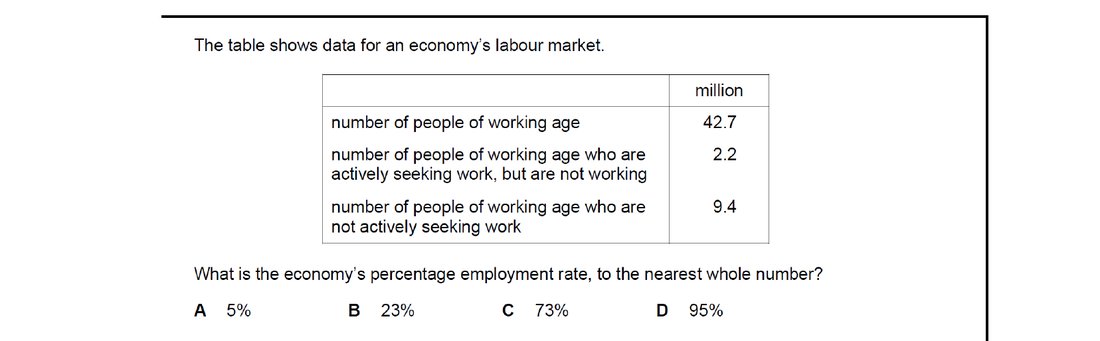
The employment rate is the share of the labour force in work, where labour force = employed + unemployed (those actively seeking). Of working age, 94m are not seeking work, leaving a labour force of 427 − 94 = 333m. Subtracting the 22m actively seeking work but not working gives 311m employed. Employment rate = 311 / 333 ≈ 93%, which rounds to the 95% answer.
19.4The stock and flow of unemployment
A stock is measured at a single moment in time; a flow is measured over a period. The level of unemployment and the unemployment rate are stocks — snapshots of unemployment at a particular point in time. They do not capture the underlying movement of people into and out of unemployment.
The level of unemployment may stay roughly constant from month to month without it being the same individuals who are unemployed. Some workers will have lost jobs in the period, while others will have found jobs, or left the labour force. One reason for leaving the labour force is becoming a discouraged worker — giving up the search for a job after a sustained period without success.
People enter unemployment for reasons such as leaving school or university, being made redundant, voluntarily leaving a job, becoming ill, stopping being a homemaker, or migrating into the country. They leave unemployment by entering higher education, finding employment, leaving the labour force through ill health, becoming a homemaker, becoming a discouraged worker, or emigrating.
19.5Measures of unemployment
Governments use two main ways of measuring unemployment.
Claimant count measure
The claimant count measure counts as unemployed those who register as unemployed to claim unemployment benefits. It is relatively cheap and quick to calculate, because it is based on information the government collects as it pays out benefits.
However, the figure may not be accurate. It may overstate the true figure by including people who are not really seeking work — some may be working and claiming illegally; some may not be actively searching. It may also understate it by missing genuinely unemployed people who do not appear in the official figures, such as those too young or too old to claim benefits, those who choose not to claim what they are entitled to, full-time students looking for work, or those whose other income is too high to qualify.
In countries with low or non-existent unemployment benefit, the unemployed may see little reason to register, so the claimant count seriously understates unemployment.
Labour force survey measure
The labour force survey measure is the more widely used method. It is based on a survey, usually using the International Labour Organisation (ILO) definition of unemployment: all people of working age who, in a specified period, are without work, are available to start work within the next two weeks, and are seeking paid employment.
The labour force survey measure picks up some of the groups missed by the claimant count. Because it uses internationally agreed concepts and definitions, it makes international comparisons easier. It also collects more information — for example on the qualifications of job seekers. Its disadvantages are that the data are more expensive and time-consuming to collect, and that they are subject to sampling error and the practical problems of data collection.
19.6The causes of unemployment
Although workers may lose their jobs for many specific reasons, economists group unemployment into three main types according to its underlying cause: frictional, structural and cyclical. Each type has different causes, calls for different policy responses, and tends to last for a different length of time. A single labour market may contain all three types at once.
Frictional unemployment
Frictional unemployment is unemployment that arises when workers are between jobs. It is generally short-term and is an unavoidable feature of a changing economy in which new jobs are continually being created and others ended. Frictional unemployment takes several forms.
The first is voluntary unemployment. This occurs when workers are not willing to accept the jobs that are available at the current wage rate and working conditions. The level of voluntary unemployment can be influenced by how unemployment benefits compare with the wages on offer. If the income a worker would receive from a low-paid job is less than the unemployment benefit available, some workers may choose to stay unemployed rather than accept the job. In most countries, however, the amount of benefit a worker receives falls after a period of time, which provides an incentive for the unemployed to take up paid work eventually.
A related form is search unemployment. This arises when workers do not accept the first job they are offered but spend time looking for a better-paid job, or one that is a closer match to their skills and preferences. Search unemployment can be reduced by the provision of more and better-quality labour-market information, as workers and employers can then find each other more quickly.
A third form is casual unemployment. This applies to workers who move regularly between short-term jobs and who are out of work between contracts. Actors, supply teachers and construction workers are common examples.
A fourth form is seasonal unemployment. Demand for workers in some industries varies sharply with the time of year. Workers in tourism, hospitality, building and farming, for example, may be in heavy demand during one part of the year and out of work during another.
Structural unemployment
Structural unemployment arises from changes in the structure of the economy. Over time, the pattern of demand and supply changes — demand for some products falls while demand for others rises, some industries expand while others contract, and methods of production change, often driven by advances in technology. When this happens, there can be a mismatch between the skills, qualifications, experience and geographical location of those who have lost their jobs and the requirements of the new vacancies. If workers cannot move between industries or regions — because of geographical immobility or occupational immobility — they may remain structurally unemployed for a long period. Structural unemployment is generally longer-lasting than frictional unemployment because retraining, relocation and acquiring new qualifications all take time.
Structural unemployment can take several forms.
- Regional unemployment arises when declining industries are concentrated in a particular area of the country, so that job losses are concentrated in that region even though jobs may be available elsewhere. Workers may be reluctant or unable to move to find new work because of family ties, housing costs or attachment to a community.
- Technological unemployment arises when labour-saving techniques replace workers. New machinery, automation, robotics and new methods of production or delivery can all displace workers whose skills are no longer needed.
- International unemployment arises when workers lose their jobs because demand switches from domestic industries to more competitive foreign industries. A country that loses competitiveness in producing a particular product is likely to see its workers in that industry made redundant as buyers turn to foreign suppliers.
Cyclical unemployment
Frictional and structural unemployment arise largely from problems on the supply side of the economy — from labour-market frictions and from mismatches between workers and jobs. Cyclical unemployment, also called demand-deficient unemployment, arises instead from a shortfall of aggregate demand. When aggregate demand falls, firms find it harder to sell their output, cut production and lay off workers. Unlike structural unemployment, which is concentrated in particular industries or regions, cyclical unemployment affects the whole economy: job losses occur across a wide range of industries at much the same time.
On a labour-market diagram, a fall in aggregate demand shifts the demand curve for labour to the left (see Figure 19.7). At the existing wage rate, the quantity of labour demanded is now smaller than the quantity supplied, and the gap between them is cyclical unemployment. In principle, a fall in the wage rate would close that gap, but in practice wages tend to be sticky downwards, and even when wages do fall, cyclical unemployment may persist. Lower wages reduce household incomes, which reduces consumer spending on goods and services. This further weakens demand for output, leading firms to cut production again and make more workers redundant. Because of this feedback, cyclical unemployment can be severe and last for a long time.
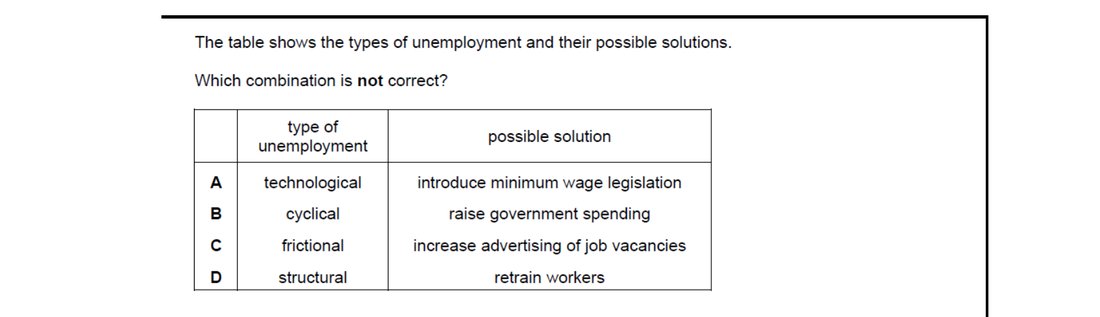
Technological unemployment occurs when workers are replaced by capital — minimum wage legislation would raise the cost of labour and make automation even more attractive, worsening the problem. The proper remedy is retraining. The other type-policy pairings are sensible: raising G tackles cyclical unemployment, better job advertising eases frictional, and retraining tackles structural.
19.7The consequences of unemployment
Unemployment has consequences for the unemployed themselves, for firms, and for the economy as a whole.
For the unemployed. Workers who lose their jobs are likely to experience a fall in income. The longer they are out of work, the harder it tends to be to get another job: they miss out on training, become out of touch with advances in technology, and may lose confidence. They may also experience a decline in their physical and mental well-being. For a small number of people a period of frictional or structural unemployment may give them the opportunity to search for a job they will enjoy more, and which may be better paid.
For firms. Firms that want to expand may have a greater choice of potential workers. Frictional unemployment helps the economy adjust more quickly to changing demand and supply conditions, with workers moving from declining to expanding industries. Firms may also benefit from workers being less inclined to push for wage rises, for fear of losing their jobs. On the other hand, firms may suffer from weaker demand for their goods and services if many households have lost income.
For the economy. The economy bears an opportunity cost: output is below its potential level. If the unemployed were working, more goods and services would be produced and living standards would be higher. Tax revenue is lower than at higher employment, and if state benefits are paid, government spending on those benefits is higher, leaving fewer resources for other uses.
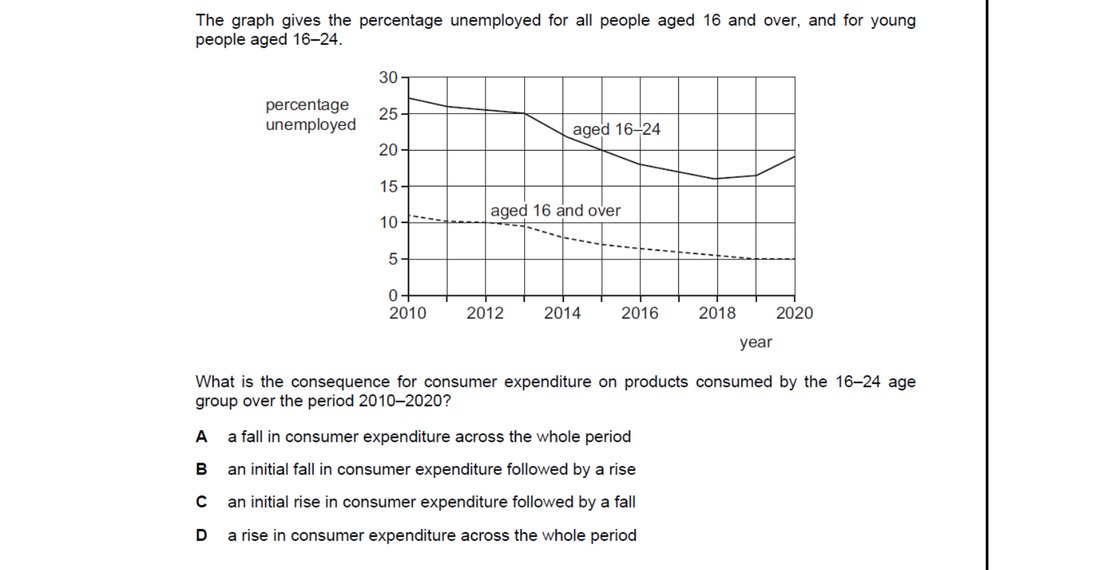
Consumer expenditure depends on incomes, and incomes for the 16-24 age group depend heavily on employment. Over 2010-2020 the youth unemployment rate first fell (rising employment, higher incomes, more spending) and then rose again towards 2020 (falling employment, lower incomes, less spending). So expenditure on products consumed by this group first rose and then fell.
19.8How significant is unemployment?
The effects of unemployment depend significantly on its rate, duration and type.
A high rate of unemployment means the economy is producing well inside its PPC and forgoing a large quantity of output. Unemployment is also more significant the longer workers are out of work: the income of the long-term unemployed is low, and they may suffer poor mental health from the stress of being jobless. The chances of finding a job tend to fall the longer a worker has been unemployed — skills become outdated, confidence erodes, and some become discouraged workers. Employers may be reluctant to take on people who have been out of work for a long time.
Frictional unemployment is regarded as the least serious type — some level of frictional unemployment is unavoidable in any changing economy. Cyclical unemployment, by contrast, can be very serious: it can affect a high proportion of the labour force and last for a long time.
Governments usually conclude that the harms of unemployment outweigh any benefits, and aim to keep unemployment as low as possible. This does not mean zero unemployment, because some always exists — the demand and supply of labour are continually changing, and some workers will always be between jobs. The goal is to avoid structural and cyclical unemployment, and to keep frictional unemployment as low as possible.
Low unemployment is not always a sign of a strong economy. Some workers may be in low-paid and insecure jobs. Others may be experiencing underemployment — working part-time when they want full-time work, or working in jobs that do not match their qualifications.
Falls in unemployment also need to be examined carefully. If the fall comes from previously unemployed workers finding good jobs, it is beneficial. If it comes from people giving up the search and dropping out of the labour force, the apparent improvement masks a worsening of the underlying situation. Unemployment is also rarely spread evenly: rates can differ between genders, age groups, ethnic backgrounds, regions and skill levels.
End-of-chapter practice
Past-paper questions from CIE 9708. Pick A, B, C or D. Answers are saved on this device — press Download report (PDF) at the top to save them.
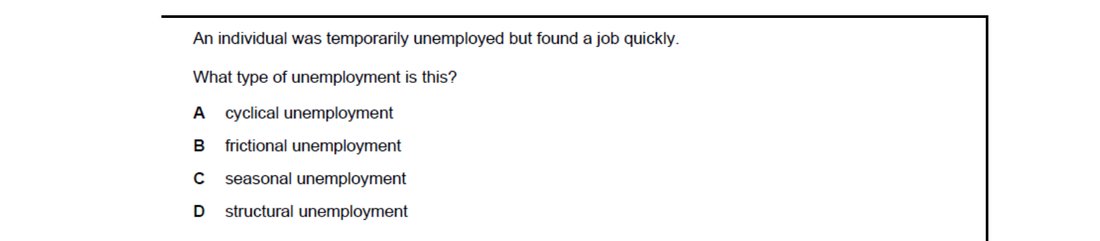
Frictional unemployment is short-term unemployment as workers move between jobs — leaving one role and quickly finding another. A worker who is unemployed only briefly before securing a new job is the textbook case. Cyclical, seasonal and structural unemployment all involve longer-lasting reasons (weak AD, time-of-year, or mismatched skills).
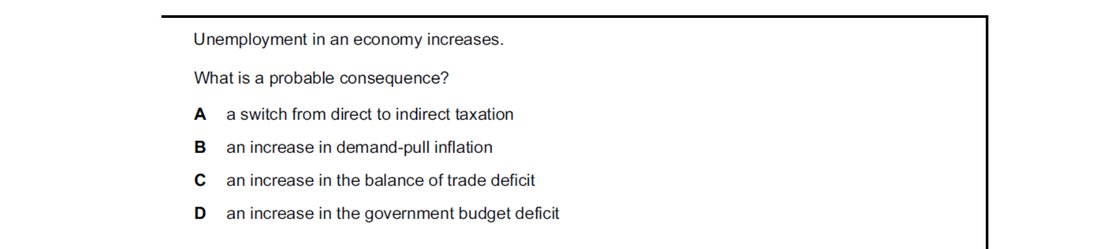
Higher unemployment cuts tax revenue (fewer workers paying income tax and NI) and raises government spending on unemployment benefits. Both effects worsen the government's finances, so a rise in unemployment is most likely to widen the budget deficit. Demand-pull inflation typically falls with unemployment, and the trade balance can improve, not worsen, when incomes fall.
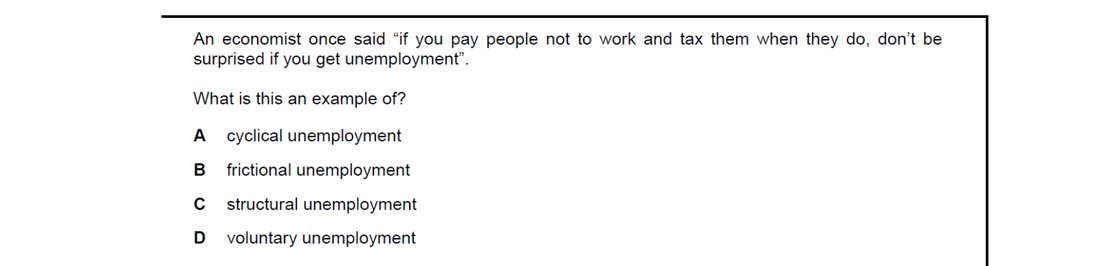
The quote describes incentives: generous out-of-work benefits raise the reward for not working, while income tax lowers the take-home reward from working. Both move some workers to choose leisure over employment — they voluntarily withdraw from work despite jobs being available. This is the textbook definition of voluntary unemployment.

The unemployment rate is the share of the labour force without work, not the share of the total population. Here the labour force is 36m, so unemployed = 10% × 36m = 3.6m. The total population (73m) and the split between primary and secondary/tertiary skills are not needed to calculate the headcount.

Unemployment rate = unemployed / labour force. Rearranging gives labour force = unemployed / unemployment rate = 5m / 0.10 = 50m. The total population (100m) is not the labour force — many are outside the working-age population or are economically inactive.

Structural unemployment is caused by lasting changes in the structure of the economy — automation, declining industries, or production relocating — that leave workers' skills or location mismatched with available jobs. Options A, B and D all describe such mismatches. A fruit picker without winter work is unemployed because of the time of year, which is seasonal, not structural.

Seasonal unemployment arises because demand for certain goods or services varies predictably with the time of year — ice-cream sellers in winter, ski instructors in summer. A temporary change in the pattern of consumer expenditure across the year describes exactly this. The other options describe cyclical (A), structural (B) and geographical (D) unemployment respectively.
Attempt the practice questions above to build your score.
Self-evaluation checklist
After studying this chapter, you should be able to:
- Understand that unemployment occurs when people who are willing and able to find work cannot find a job.
- Explain the difference between people who are economically active and economically inactive.
- Explain the difference between the level of employment and the rate of employment.
- Calculate the rate of unemployment.
- Explain the two main methods governments use to measure unemployment: claimant count measure, labour force survey measure.
- Explain the advantages and disadvantages of the claimant count measure and the labour force measure.
- Explore the three main types of unemployment: frictional, structural, cyclical.
- Discuss the negative and positive consequences of unemployment.
Want more practice? Drill this chapter's past-paper MCQs (55 questions) →